Volunteer Jane explores the story of the SV Charlwood, one of the vessels investigated as part of the Metal Hulled Sailing Vessels Project.
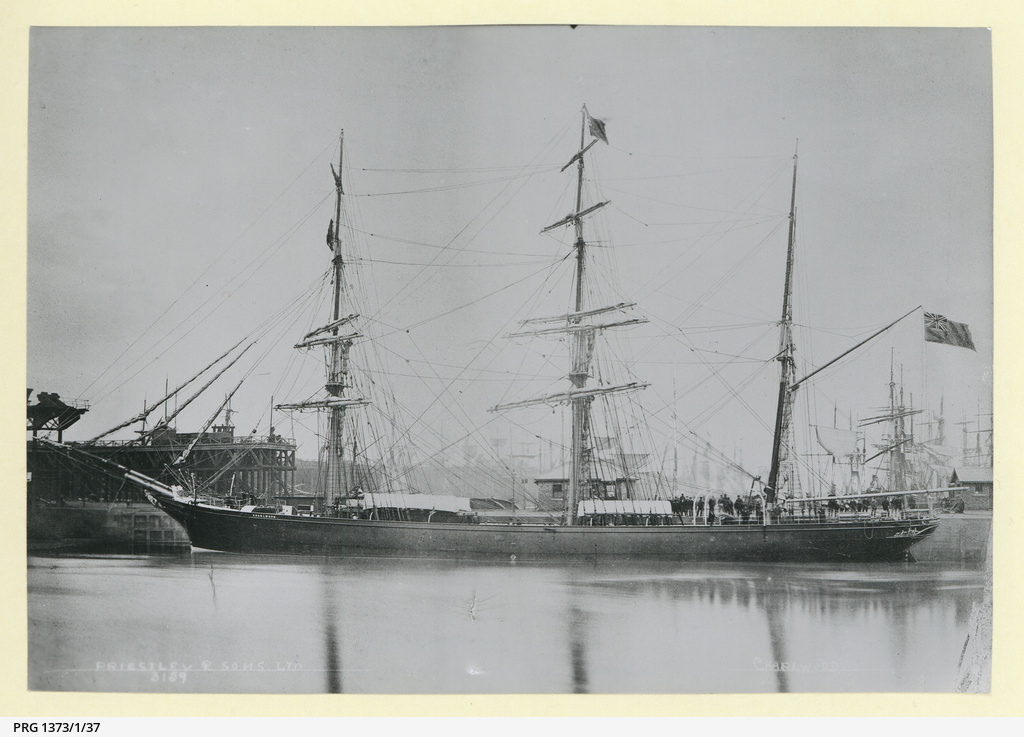
The Charlwood just after completion.
Courtesy of the State Library of Australia, A D. Edwards Collection [PRG 1373/1/37]
On 26 October 1891, the three-masted, iron-hulled sailing vessel sailing vessel (SV) Charlwood, on passage from Antwerp to Valparaiso, Chile, was wrecked during a collision with the steamship (SS), SS Boston, to the east of the Eddystone Lighthouse, about 9 miles south of Rame Head in Cornwall, England. The SS Boston, travelling with a cargo of coal from Cardiff to London, struck the Charlwood amidships on the starboard side cutting the vessel almost in two, leading to the tragic loss of most of the crew and passengers on board the Charlwood.
The SV Charlwood was a fully rigged barque built near Sunderland in 1877, in the William Doxford & Sons’ Pallion Yard. The vessel was 197.7-feet long and 32.3-feet wide, with a draught of 19.6 feet. The ship was launched on 1 July 1877 and registered in Liverpool, England, on 21 August 1877. It was first owned by G. H. Fletcher & Co. and only changed hands once, when the vessel was sold to Thomas H. Jackson, of Liverpool, in 1888. Engaged in global trade until it wrecked in 1891, most voyages were between British ports and a variety of locations in South America, its maiden voyage having been to the west coast of South America.
Doxford and Sons was founded by William Doxford, Sr., in 1840, and initially the shipyard focused on wooden shipbuilding but, by 1864, when the oldest of his sons was working with him, the yard had begun to build iron ships, which enabled the business to grow dramatically. Eventually, all four of Doxford’s sons joined the family business, taking over completely when their father died. In 1872, the company received the first of many ship orders from the Admiralty and continued to grow, becoming known for fast sailing clippers and liners and, later, also moving into the manufacture of marine steam engines and boilers. From 1905 to 1907, the Doxford & Sons yard had the highest production level of any shipyard in the world. They built the Charlwood in the late 1870s, just as the focus was shifting from sail to steam.
Research in the British Newspaper Archives revealed that the Charlwood often carried general goods, while more specifically known cargoes included coal, bar iron, iron plates, nails, nail rods, bicarbonate of soda, wheat, nitrate, and manganese ore. Throughout its life, the vessel traded all around the world, primarily between British ports and a variety of locations in South America but also made several voyages to the west coast of the United States, and to Australia, New Zealand, and Japan. An article from the Daily Gazette for Middlesborough, dated 13 November 1879 noted that the vessel was in Middlesborough, loaded with cargo for Yokohama as follows: “1,000 tons bar iron, 22 tons iron plates, 20 kegs nails, 50 tons iron nail rods, 50 tons bicarbonate soda.”
On its final voyage, the Charlwood departed Antwerp on the 16th of October under the charge of a Falmouth pilot called Loosemore, who disembarked the Charlwood onto a fishing boat so he could be taken ashore to Plymouth, about an hour before the collision occurred. The weather at the time had been clear and all was going well, but the night was very dark, and a strong breeze was blowing from the east; at about 04:30, the Boston struck the Charlwood.
The lifeboat was immediately lowered, and the captain’s wife, his daughter (aged 13), a governess, a servant girl, and the captain’s son (aged 11), together with several of the crew, got into lifeboat, whilst the captain remained on the poop deck giving orders. However, the Charlwood took on water so rapidly that before those in the lifeboat had time to push off, the Charlwood foundered and davits caught the lifeboat and upset it, so that its occupants were thrown into the water. Those struggling in the water attempted to catch hold of pieces of spar, paddles, and any other floating wreckage. After the Boston managed to clear the wreck, it lowered a boat, as did a passing schooner, the Albion. The two vessels were able to rescue seven people who were then taken to Falmouth by the Boston, including four able seamen, two apprentices, and the captain’s daughter.
The fifteen people who drowned were Captain Hiscocks, his wife, son, governess, and servant girl; and from the crew, the first and second mates, the carpenter, the cook, four able seamen and two apprentices.
Ernest Alfred Roberts, one of the apprentices who was rescued, had not long before, experienced a similar disaster, having been wrecked 400 miles north of New Zealand, and, with others, had spent 108 days on a desolate island, suffering great privation. He provided the following detailed account of the Charlwood tragedy in Reynolds Newspaper on 1 November 1891:
“We sailed from Antwerp a week last Friday, and anchored off Flushing [Vlissingen] that night, where we remained until the next Thursday. We then set sail again, and as soon as we got outside we fell in with heavy gales, and were driven up the North Sea. We got off Dover last Saturday with a fair wind, which continued on Sunday, and we went down the Channel at about ten or eleven knots per hour. About a quarter-past four o’clock on Monday morning we dropped our pilot (a Falmouth man) off at Plymouth, and he wished us a prosperous voyage. We had shortened sail for this purpose and after he left us all hands were setting sail again until about a quarter to five. The bell then rang for coffee, and we went below, except the man at the wheel, the look-out man, and the officers on the poop. We had been below about ten minutes, when I heard the captain, who was on deck, shout, ‘Where on earth is she going?’ Then he cried, ‘Oh, you rascal!’ I at once ran up on deck—about six or seven steps from where we were—and immediately caught sight of a steamer about fifty yards away on the starboard side, coming right into us. I got up on to the main deck with the idea of jumping on to the steamer when she collided, but I was too far away, and seeing there was no chance there I ran on to the poop and helped to get the lifeboat away. The captain told me to call his wife and the women and children from below, which I did. I saw two women with children come on deck, and assisted them in getting into the boat, a few men being put in charge. The captain was at this time still standing on the poop giving orders. The lifeboat was launched safely, but shortly afterwards the vessel gave a lurch, and a davit catching the boat capsized it, the occupants being thrown into the water. I then began to think about myself, and ran forward to see if I could get hold of a wheel grating or something to support me. I noticed a life-buoy hanging over the stern, and cut it adrift, putting it over my shoulders. I cast a quick glance around, and saw no one on the poop. I was then just about to jump overboard when a big sea struck me, and I was washed from my position and got entangled in the main braces. The vessel went down immediately, and I went down with her for about two fathoms, but I succeeded in kicking myself free, and came to the top. The women and children were then screaming fearfully in the water. I could hear them but could see nothing, as it was pitch dark. After I had been a quarter of an hour in the water, a man clutched hold of me, seeing me with a lifebuoy, and held fast. We both kept sinking and rising for some time, and I found his weight very heavy. I then said to him, ‘You will have to look out for some wreckage.’ Fortunately we came across a wheel grating floating in the water, and we both seized it. We put our fingers through the latticework, and kept hanging on for a long time. It seemed to us that we had been two hours in the water, but the steamer’s crew afterwards told us that it was only three-quarters of an hour. I saw a white light, about half a mile off, and that was the last I recollect, for I then became unconscious, and knew nothing more until I came to myself on board the steamer that had picked us up. We were then running for Falmouth, where we were landed about 1.30 p.m. Messrs. Brodrib and Sons took charge of us, and we were fitted out and sent on to Liverpool. The captain’s daughter was one of those put in the lifeboat and thrown into the water, but she got hold of the lifeboat which righted itself, and she and another were picked up by the brigantine Albion.”
The Charlwood sank in open water so quickly and to such a depth that historical salvage was not possible. In late November 1891, a court case between the owners of the two vessels was settled, though the terms of settlement are not outlined (Liverpool Journal of Commerce, 27 November 1891). The same newspaper account notes that the Liverpool Shipwreck and Humane Society had just awarded a silver medal and vote of thanks to William R. Downie, the other surviving apprentice. Downie was in the sea after the wreck, floating on a hencoop and heard the captain’s young daughter calling for help. Although he could not see her, he left his position and swam toward her cries to find her clinging to the lifeline of the lifeboat that had earlier capsized. Both were able to get into the boat and were eventually saved by the Albion.
A final note concerning the collision comes from the official Board of Trade Inquiry [1891], which convened at Liverpool in December 1891 to investigate the loss of the Charlwood. After hearing testimony from surviving crewmen and officers from both vessels, the Court concluded that the disaster resulted from the “improper and negligent navigation” of the Boston. The inquiry found that the steamer had failed to maintain a proper lookout in dark and unsettled weather conditions and that insufficient avoiding action had been taken when the sailing vessel was sighted. Particular blame was assigned to the Boston’s second officer, Charles Henry Gale, whose handling of the vessel was judged negligent under the collision regulations then in force. The Court further determined that the Charlwood had been properly navigated as the stand-on vessel. Because of the findings, Gale’s certificate was suspended for six months. The inquiry also criticised the inadequate stowage of lifebelts aboard the Charlwood, noting that many crew members were unaware of their location, a circumstance that may have contributed to the heavy loss of life following the sinking. A final outcome was that the court was of the opinion that the master of the Boston was open to censure because he was on deck at the time and should have satisfied himself that countermeasures were undertaken to avoid collision after the first sighting of the light of the Charlwood [Board of Trade Inquiry 1891].
Despite being a fairly deep wreck at approximately 60 metres, a number of technical diving groups and skilled individuals have visited the site over the years. The Plymouth Sound Divers BSAC group has three web pages related to the site and to their dives on the wreck. In a number of instances, these pages include images taken by Dominic Robinson, one of the key individuals involved in diving the wreck (see links below).
The Charlwood now sits upright on the seabed at a depth of 63 metres. Much of the wreck stands well clear although, towards the stern, the wreck has collapsed. The bow seems squared off as if it has broken and collapsed forward of the first bulkhead. In this collapsed area can be seen the base of the bowsprit. On the starboard side, forward of the main collapsed area are a number of barrels and, in several areas of the wreck site, are deposits which appear to be hardened tar or pitch left behind when the barrels in which these was stored have rotted away. The stern area is much flatter although there appears to be a rudder laying on its starboard side under other debris, which includes a vast quantity of low-quality glassware.
Some of the raised artefacts from the Charlwood that have been registered with the Receiver of Wreck include:
- 3 x 16″ high glass decanters, probably Victorian, 3 x 3.4″ drinking glasses, and a pint glass.
- 6 pieces of glass decanters, 50 ampoules and 30 clear bottles, 20 glasses, 12 dark bottles, and a bedpan.
- 2 glass decanters, 6 glasses of various types, and a glass object, purpose unknown.
- Two glass decanters, two glass vases and a glass stopper.
- A corroded cast bronze female figurine with one arm raised, 12” high.
The Charlwood’s final voyage, from Antwerp to Valparaiso, Chile, was a route that it had sailed several times before and, this time, the cargo appears to have been primarily trade glass possibly created for the export market, including a variety of Victorian tumblers, wine glasses, decanters, plates, cups, bottles and sheet glass. The site is therefore often referred to as the ‘Glass Wreck’.
The wreck has been positively identified as the Charlwood by the discovery of the brass ship’s bell marked “Charlwood 1877 Liverpool”.
Link to another MAT blog on the Charlwood: https://maritimearchaeologytrust.org/the-metal-hulled-sailing-vessels-project-the-charlwood-and-kate-thomas/
Other links of interest:
Board of Trade Inquiry Report: https://plimsoll.southampton.gov.uk/SOTON_Documents/Plimsoll/15962.pdf
Charlwood (Sunderlandships.com): https://sunderlandships.com/view.php?ref=100924#v
Charlwood (Historic England, Hob Uid 1440931): https://historicengland.org.uk/listing/heritage-gateway/results/record/0d636742-8028-4a8c-8b7c-e1f9aaf2d338/3ab213bc-7485-4a68-9b73-29a376f561ec
Dive pages related to the wreck: