
Volunteer Jane Thackker explores the story of the Royal Adelaide, one of the wrecks investigated as part of the Metal Hulled Sailing Vessels project.
The Royal Adelaide departed London on 14 November 1872 en route to Sydney with a crew of 30, a passenger list of 37, and a general cargo of 2,900 tons. The ship was towed as far as Dover and then made sail down the channel in an easterly wind. As the wind turned to the southwest, it managed to beat down as far as Start Point, but was held back by ‘boisterous’ weather until the 24th when the ship was able to continue its westerly course. However, before midnight the wind increased again and the severe weather encountered on 25 November 1872, reported to be west-southwest at 10 miles per hour, made the master decide to attempt to put into Portland Harbour.
The Royal Adelaide was a full-rigged, iron-hulled sailing clipper built in 1865 by William Patterson of Bristol. The ship was 233 ft long, 39 ft wide, and had a draft of 23 ft. The ship was owned by Fernie Brothers and the Merchants Trading Co Ltd, the latter being an umbrella organisation operated by the Fernie & Brothers group. Its sister ship, the Royal Sovereign, was also built by William Patterson in the same year and the two ships were the largest iron sailing ships built in Bristol and the last built by Patterson. Launch reports from January 1865 note that the hull was perfectly smooth, approaching the appearance of enamel due to a special coating.
The ship operated in much the same fashion as a modern container ship, taking on shipments until the hold was full enough to make it economically advantageous to set sail. The majority of voyages were on the Liverpool–Bombay run, but it called at other ports including Penang and Calcutta.
The Liverpool Journal of Commerce of 30 October 1868 lists the cargo that was unloaded at Liverpool Albert dock, Warehouses 6 and 7, on 27th October on a return voyage from Calcutta. Not all entries are completely legible, but it appears that for Fernie and Sons the ship carried 610 bags of saltpetre and for Raili, 555 bags of saltpetre. For Timavaco, it carried 126 bags of rice, for H H Notenius 99 packets of oilcakes, for H Burrows 1 cask of glass and for Ogilvy & Gillenaders & Co 400 bales of cotton. For Mathieson & Co, the vessel carried 4957 bales of cotton, 126 bags of tincal (a naturally occurring mineral form of borax), 2342 bags of sugar, 1365 bags of (??), 2500 packets of linseeds, 2125 bales of jute, an amount of wine and 2 cases of bitters. [(??) Indicates unable to read as scan is off the page.]
It was likely that the cotton was destined for the mills of Lancashire and that the oilcakes, the matter remaining after the pressing of items such as peanuts, coconuts, and sesame, would be used mostly for animal feed. The saltpetre would be used primarily for the manufacture of gunpowder or in fertiliser.
A major source of saltpetre was bat guano, which was leached to produce nitre water and then boiled to concentrate the resultant liquid from which the saltpetre was obtained. The British East India Company had previously secured significant contracts for the mineral in India, and the Ganga River valley was one of the richest sources of saltpetre globally, making it a strategic asset for the British and a key export.
On Royal Adelaide’s final voyage, the cargo seemed to include mostly gin and brandy, including a rare, refined form of Dutch gin known as Wolff’s Aromatic Schnapps.
Arthur Mazo, a Chesil pilot, was on the beach at 04:00 am on Monday 25 November and saw the ship about 2 or 3 miles offshore and said if he had been aboard the vessel at the time he would have beatenit out of the cove. However, the Royal Adelaide was driven ashore on the Monday evening and struck Chesil Beach broadside on. As the vessel was battered by the surf, it broke up rapidly and began to disgorge cargo onto the beach where a crowd of more than 1000 waited, the word having spread about the vessel’s stranding. The first items to be cast on the beach, spreading a mile towards Portland, were dozens of casks of gin and the crowd went mad, punching holes in the casks to get to the liquor. It was said that by dawn on 26th November no less than 20 of these people lay dead on the beach, succumbing to exposure in the harsh November conditions, having collapsed senseless after drinking the plundered spirits.
After the ship struck, the local coastguards carried out a dramatic rescue, using rocket apparatus to carry a line aboard and continued the work for two hours after the ship stranded on the beach. The mate of the Royal Adelaide, Mr Powell, drowned while attempting to swim ashore with a line and, when the passengers refused to use the cradle designed to carry them ashore, the captain grabbed a child and went with it to set an example. The rest then followed, but five passengers were unable to be rescued and were lost.
The story of the Royal Adelaide’s loss was widely reported, often in extensive details by many newspapers. Mention was also made of the looting of the wrecked vessel, and the Western Daily Press of 17 December provided a detailed account of the charges heard in a court of session, and an extract is given below:
A special session has been held the Shire Hall, Dorchester, to hear charges of being in illegal possession of cargo belonging to the Adelaide, and refusing to deliver the same to the Receiver of Wreck. There were 18 summonses. Mr Giles Symonds, Town Clerk of Dorchester, prosecuted on behalf of the Board of Trade; Mr. Weston defended several of the accused persons, each of whom was liable to a fine of £100. By the testimony of the police it was shown that on the night of wreck a large quantity of the cargo carried away, including spirits. The first case disposed of was that of Henry Bond, a private the 77th Regiment, who had taken five bottles of spirits, for which offence the officers of his regiment had already sentenced him to 28 days imprisonment; the bench now ordered him to pay 5s and costs.
A Board of Trade inquiry, which began on the 3 December 1872 and was held at the Guildhall, Weymouth, focussed on the circumstances of the loss of the Royal Adelaide, and was widely reported on across the country. The captain, William Hunter, claimed that he had done all he could to get the Royal Adelaide out of the West Bay and recounted how he had attempted to return to the ship to rescue others but was prevented, though other witnesses debate over the truth of this claim.
The inquiry ended in December and Hunter was blamed for its loss, the court’s judgement being detailed in the Manchester Times of 1872:
‘The following is a copy of the judgment of the Court:
“In reviewing the circumstances attending the loss of the Royal Adelaide the Court must notice the great want of caution exercised by the master in attempting to run into Portland Harbour without having made the Shambles light vessel. From the courses steered it seems a miracle that the vessel was not lost on that dangerous shoal. At seven a.m a bearing of the Portland light was obtained, N. ½ W.; at eight a.m. the ship was steered N.N.S.(?) towards the roadstead. At that time the weather was so thick that the Shambles light vessel could not be seen. Nevertheless, the master, though uncertain of his position, altered the course to N.N.W., fortunately cleared both the Shambles and the Bell of Portland, and took the ship into West Bay. The Court is of opinion that the master was not justified under these circumstances in thus attempting to run into Portland. His ship was neither crippled nor in distress; and being doubtful of his position, he had the alternative of hauling his ship to the southward, and awaiting clearer weather. Again, when he found himself in a difficulty, had he had recourse to his deep-sea lead, instead of the hand lead, he would have found, by a reference to his chart, that he was to the westward of the Bell of Portland, instead of to the eastward of the Shambles as he supposed. Taking all these circumstances into consideration, the Court cannot attribute the loss of the ship to stress of weather, but rather to the rash neglect of those precautions which an experienced master mariner is expected to exercise in cases of difficulty and danger. The Court cannot, therefore, overlook the want of due care manifested by the master whereby a valuable ship has been lost, and several lives sacrificed. The judgment of the Court is that the certificate of competency of Mr. William Hunter be suspended for the term of twelve calendar months from this date. The Court think it right to observe that they have not been directed to inquire into any of the circumstances which occurred subsequent to the stranding of the ship, an official investigation having already been made at Weymouth, and the report sent into the Board of Trade”
Due to public interest many people tried to raise funds for those who had been shipwrecked and who had lost their possessions. Captain Piers of Weymouth appealed to Germans residing in England on behalf of a widow of one of their countrymen, who sacrificed his life while helping to save others. A reply from Captain Hamilton appears in the Tamworth Herald of 14 December 1872;
“My dear Piers,—ln reply to your note, I believe the German you allude to. J. C. F. Magdelinsky, was the last man who got into the cradle, and unfortunately, just as he was lowered into the surf, the ship broke up, the cargo swept out the hold, and it is supposed some of the cases struck him and parted the line communicating with the ship. Mr. Menifield, chief officer, Wyke station, saw him examining the rope carefully, as if apprehensive his weight was too much for it. The cradle was on board for some few minutes before he got into it; had he done so at once, his life would have been saved. The delay might have been caused by his making a last attempt to save Mrs. Fowler, as from all accounts he was the ruling spirit on board the ill-fated ship, and did more towards sending people ashore than any one on board, and having seen his own wife saved it is sad to think the poor fellow fell a victim to his noble efforts to save others, when half a minute sooner would have saved his —Believe me, yours very truly, E. V. HAMILTON. Her Majesty’s ship Achilles, December 6.”
Mr Eliot of Weymouth also wrote on behalf of a sailor who had behaved gallantly
“As the public attention has lately been directed to this disastrous wreck, may I be permitted to make an appeal on behalf of one of the survivors. One of the crew, who was mentioned in the report, the black sailor who acted so bravely in assisting the women and children in leaving the vessel, and was himself one of the last to leave the Royal Adelaide, was much injured In getting to shore. Since the wreck he has been in the hospital in this town, where, I am happy to say, he has quite recovered from the injuries received. As this the third time he has been shipwrecked, he is not unnaturally anxious to get some situation on shore for the future. He is a tall, powerful man, aged thirty, bears a very high character, and is of a gentle, kind disposition ; he has filled the situation of butler in an Englishman’s family at St. Vincent, his native place, he might prove a faithful and valuable servant to any one who did not object to his colour. He speaks English very well. Any further inquiries I shall be happy to answer as far as I can”
The Shipwrecked Mariners Society, through their agent Mr A Dawson of Weymouth, were committed to providing for the wants of the shipwrecked passengers and crew. They were fed and clothed and sent to their respective homes free of cost. Henry Edwards, MP for Weymouth, gave funds to the mayor for distribution, so that every man, woman, and child received one sovereign.
Roberts and Co., ship brokers were appointed as agents and claimed full possession of everything acquired by the Receiver of the Wreck, on behalf of the Ship’s owners. The auction was advertised on Lloyds List of 13 January 1873, with details of the cargo for sale:
- and W. LYON will SELL by PUBLIC AUCTION, on THURSDAY, the 16th inst., at 830A Old Kent
(where the goods may be Viewed on Wednesday), SALVAGE ex this Vessel, consisting of Sheeting, Calico, Sewing Colton, Sail Canvas, Rope, Linseed Oil, Varnish, Painters’ Sundries, 20 bales Corks, Cocoa, Preserved Provisions, Flour, Bottled Beer, Pickles, Vinegar, Sardines, Saddlery, Hats, 10 cases Paper, Meerschaum Pipes, Surgical Instruments, Cutlery, Medicines, Hops, 100 Guns, Oak Pulpit and Reading Desk, Church Lamps, American Stoves, &c. Catalogues on Tuesday next of J. A. and W. LYON, Marine Salvage Brokers, Cowper Court, Cornhill, E.C
Various items have been recovered from the wreckage, such as a child’s leather shoe and a lump of coal, which are displayed at the Dorchester Museum, and a lead pump, sewing machine, and a stock and die displayed at Weymouth Museum. It is, however, somewhat unclear whether all of these items were washed onshore with the cargo or taken from the remains of the ship afterwards. The Portland Museum also holds some items, including a full-size replica of the ship’s bell and a number of items recovered from the site, including several pairs of shoes and boots, clay pipes, and knives and forks. The latter may have been part of the cargo intended for colonists in Australia.
The site of the remains of the Royal Adelaide is now ‘substantially broken up.’ Features such as a foredeck winch, chain locker, and other ‘large wreckage’ remain, but that part of the hull which remains today is being rapidly eroded as it is regularly `shot-blasted’ by millions of Chesil pebbles.
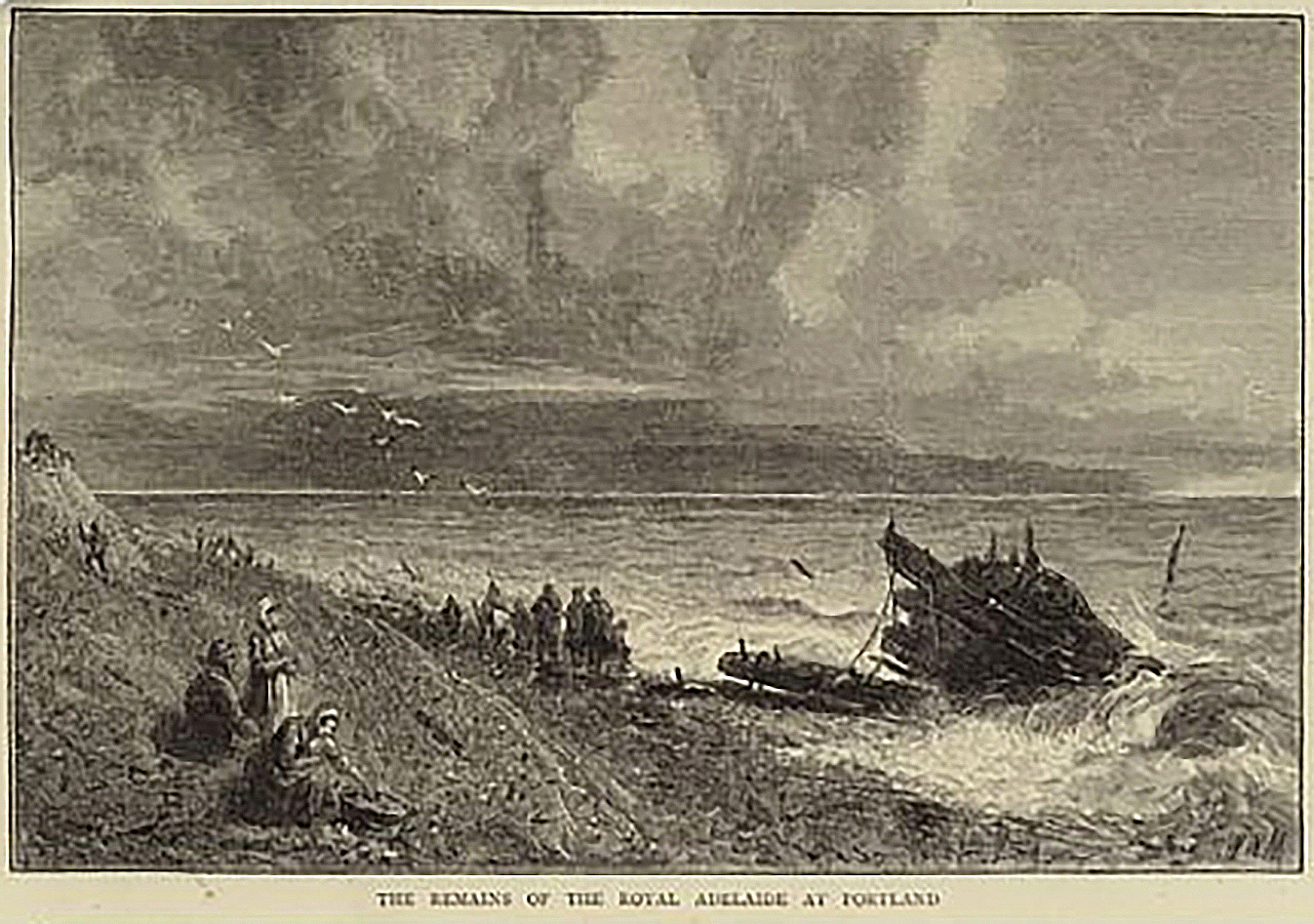
The Remains of the Royal Adelaide at Portland (engraving).
English School, (19th century) Illustration for The Graphic, 14 December 1872. Artist Walter William May

Appendix
Detailed Report of Board of Trade Enquiry from Tamworth Herald of 14 December 1872
The official inquiry into the circumstances attending the wreck of the Royal Adelaide was resumed on Saturday, at the Guildhall, Weymouth, before Captain Wilson, an inspector of the Board of Trade, when some new information was obtained. Richard Cox, of the firm of Roberts and Co., ship brokers, proved that the captain of the ship appointed them as his agents, and they claimed full possession of everything from the Receiver of Wreck on the part of the owners of the ship. He thought that everything had been done which was possible for the protection of the property cast on the beach, and said that he had received every assistance from all the Government officials. He saw very little drunkenness on the night of the wreck, but the next day saw people dead on the beach through drink, while there was a large number of intoxicated persons about. He told all the Government officials they ought to prevent that as much as possible, but he did not believe that a thousand men would have prevented it, as the wreck extended for about two miles, and people buried bottles containing liquor in the pebbles. He admitted there were ” disgraceful scenes ” on the beach, but thought the accounts had been much exaggerated. Samuel Smith, one of the volunteers who assisted the Coastguard, gave some information. After having detailed the preparations which had been made by Coastguard to save life, he said that when the ship came on shore he saw some Portland fishermen tying ropes round their waists to run into the suit. A man named Shaddock rushed into the sea secured by a rope from the shore, and succeeded in throwing a line with a heavy piece of lead attached to it on board. The first mate had tried to bring a rope on shore, but was drowned in the attempt. There was some hesitation about hauling the Portland line on board, as the people did not appear to know whether to haul that one or the one which the mate had tried to send on shore. The Wyke Coastguard made fast the whip and the hawser by the line which the Portland man had sent on board, and these were hauled off. There seemed to be confusion on the beach as to whether the hawser should be used or not, as the ship was rolling so very much. He did not think it could have been used on this account. If the breeches buoy had been used in accordance with the Board Trade directions, some of the people brought on shore would not have been wet. He would not say that the loss of life occurred on account of this not having been done. He had a rope around his body and assisted in taking about persons out of the Wyke breeches buoy. The first man who landed was a [black sailor], but he wanted to go on board again. He stated that there were 60 or 70 people on board, and that he had left the ship to show them there was no danger. Witness then saw Mrs. Irons get into the buoy, but she got hold of the mainbrace pennant, so that when this was hauled she was pulled out of it and drowned. The work of saving life then went on very rapidly, 14 or 15 persons being saved when the blue lights went out. The third person who got into the basket was a woman; men and women came at intervals. In the darkness the basket was hauled on shore and a woman nearly drowned. He heard afterwards that she had brought a child, but this was washed out of her arms. Soon after the mizzentopgallant mast fell, which had the effect of lowering the block of the apparatus, so that the buoy hung over the ship’s side to a considerable extent. The master was the sixth person who left the ship, and the fourth to land. He came on shore with a child in his arms. Witness was assisting him out of the apparatus with other men when a sea knocked them all down. When he got up the child had been taken out of the captain’s arms, and he assisted to get him out of the breeches buoy. At that time he did not know who the man was. He asked him how many people were on board, when he replied, ” Between 60 and 70.” He then said, ” I am the master of the vessel.” The people who landed came in the following order :—First, a [black sailor], then a man, then a woman, and then a man who told me he was the master. He said he could get no one to take the children, and brought one himself. A minute or two afterwards witness heard he wanted to go on board again, but he was not allowed. The last man who came on shore was the second mate. He said that there were a man, woman, and child on board who could not get into the buoy. The apparatus was then sent off again, but after a long delay a man made his appearance on the poop. By this time the ship had gone to pieces, there was nothing but a bit of her stern left. The man at the poop got into the buoy. something in his arms which was thought to be a child, said by the second mate to have been left onboard. The line was hauled from the shore, but broke, and man, basket, and line were lost among the wreckage. He thought he saw the man amidships, and attempted to save him, but was knocked down by a very large case, and it was with great difficulty he got out of the surf. By this time the cargo was washing about in all directions. Edward Way, a licensed pilot of Portland, spoke to the state of the tide and wind on the day the Royal Adelaide was lost. The wind veered from south to west-south-west, and rather steady. He thought that if he had been a pilot on board he could have got the ship out of the Bay at four o’clock, if all her equipments were sound and good. He should have set the mainsail and upper topsails if they could have stood. The ship required all the sail which could be put on her to carry her out of the Bay. Samuel Irons, the passengers’ steward, said that shortly before the ship struck the captain said to him, “ I am afraid the ship is lost; keep the passengers below until she strikes, and then await my orders to fetch them out.” -” He kept them below until she did strike, when he passed them to the captain, who was attending the life-saving apparatus on the backstays of the mizen rigging. The captain was directing all that was going on. He heard him persuade the women to get into the cradle. The second mate, carpenter, and captain were directing the apparatus. He passed his wife and Mrs. Lambert into his hands, but he could not say when he left the ship. When witness left there were ten or twelve passengers on the poop. He did not see the captain anywhere when he left. The second mate and two able seamen were working the apparatus when he came on shore. He saw no women on board when he left, but he had since ascertained that there was an old lady, a saloon passenger. The was no scrambling or pushing to get into the cradle while the children were being sent on shore, as the captain would not allow any man to go. He would swear he saw no men go on shore until after the women had left, and also that he did not see the master go on shore. John Woolley, the second mate, was next called. He said he wished to make one or two alterations in the deposition he made before the Collector of Customs, as he had confounded the ship’s course on Saturday with that of Sunday. He did so, and was afterwards cautioned to be careful as to the answers he made. He then detailed what was done from Sunday until the ship struck on Monday night. When this happened the first mate took line with the intention of swimming on shore, as it did not seem any distance off. Finding he could not do so on account of the fearful surf, he was pulled back, and had almost reached the rail when his strength was exhausted, and before anyone could get hold of him he fell into the surf and was drowned. In the meantime, a line had been sent on board from the shore with a piece of lead attached. This was pulled in and brought off a block and tally, on the latter being the words, ” Make this fast to the strongest part of the ship.” The line was made fast to one of the backstays in the mizzen rigging, as high as he could reach from the rail. He had scarcely got the tall block fast before the breeches buoy came off. He then called on the captain to send the women along. The first person to get into the breeches buoy was a [black sailor] named Fisher. He told him to get into it to see if the rope was all right. He was hauled ashore almost as soon he was in it, and the buoy sent back again. He and the carpenter were sitting on the rail “straddle legs,” getting the people into the buoy, which was between them and about two feet below the rail. The people came very orderly and only one at a time. He heard the captain giving directions. The first person to get into the buoy after the [black sailor] was Mrs. Irons, the steward’s wife, but she caught hold of the pennant of the main brace instead of the slings of the buoy. The people on shore, seeing a woman in the apparatus, hauled the whip, which took the buoy from her. She hung with both hands to the pennant brace for a second or so and then fell into the water and was drowned. He called out to the captain, “One woman gone.” Mrs. Lambert came next, then Mrs. Bunyan, next Mrs. Austin, then several men and a woman. He did not see the men bring any children with them. After these had left the ship the lights on the beach went out, which frightened the people on board, and women began to scream. When the lights were again burning the buoy was sent back to the ship, but no one could get in it. People were greatly frightened, the ship was bumping heavily, and the sea making clean breaches over her. The captain then came forward with a child in his arms, and as the ship was breaking up so fast witness thought it did not matter who went next; he thought about going next. He sent several women and children on shore after the captain had left. He would swear he passed four or five women into the buoy before the captain left, and they went in the order he had named. The carpenter left after the master went on shore, he believed he went by the apparatus in the main rigging. Witness remained his post until only the poop of the ship was left. He left two or three people on board, He made more than one attempt to get Mrs. Fowler out of her cabin. She was in bed. He gave her a lifebuoy, but could only get screams from her. Before he left the ship he saw that the line was stranded. He believed the captain did all he could to get out of the bay. He thought it would have been impossible for the ship to carry more sail than she had on. Captain Wilson said they had come to a point where this voluminous evidence might be brought to a close. The court would now adjourn altogether to enable him to consider what report he should make to the Board of Trade. He thanked the Mayor for his kindness in placing the hall at his disposal for conducting the inquiry. ‘