
Volunteer Jane tells the story of Arctic Stream: one that captures both the endurance of the great sailing ships and the unforgiving nature of the sea. From record-chasing voyages to a dramatic final wreck off the Northumberland coast, its long career reflects a changing maritime world – and the bravery of those who sailed, and saved lives, within it. This vessel was researched as part of the Metal Hulled Sailing Vessel project.
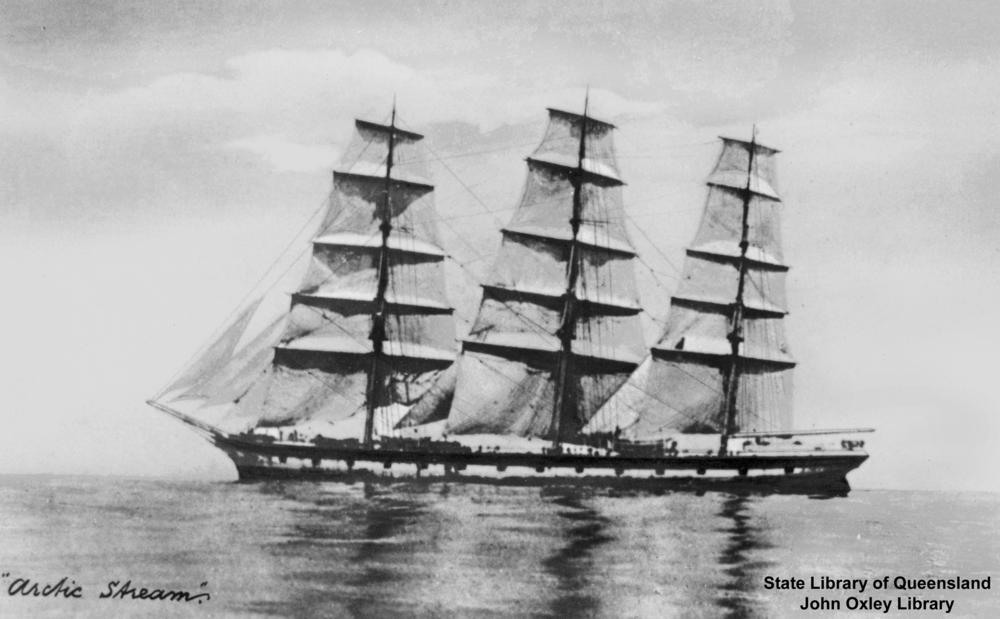
Artic Stream, location unknown.
Over the weekend of 21st and 22nd February 1914 the British Isles were hit by violent gales and, although the loss of life was, fortunately, very small, several ships were wrecked, one of which was the full rigged, three masted, iron sailing ship, Arctic Stream.
Arctic Stream had been built in 1885 by Russell and Co at Bay Yard, Port Glasgow for A L Polson as the second ship in his new company’s fleet. In 1891 it was acquired by Messrs Thomas Law and Co for the Shire Line’s extensive fleet of commercial sailing vessels and spent the rest of its career sailing under these colours.
Registered in Glasgow at 1,584 GRT, with a length of 250.3 ft, it was said to be one of its builder’s finest models and one of the fastest in the Shire fleet, never failing to turn in above average times on passage, often within a day or two of the record. Although it did not actually break any records, its successive captains knew how to get the best from her, and her most well known run was a celebrated race back to Europe from Sydney in 1907, against a German Merchant Navy crack training ship, Herzogin Sophie Charlotte, which had up to 60 cadets on board at any one time. The race was officially declared a dead heat, but the true victory belonged to Arctic Stream given the advantages obtained by the massive German barque, with its four masts, greater length and more numerous crew On another voyage it made 6000 nautical miles in a month, equivalent to 180 nautical miles per day, making it comparable to the steamships of the time.
In its early years it sailed mainly between Britain and India carrying cargo for the British India Steam Navigation Company, subsequently going on to make regular passage between Ireland and Burma, via the Netherlands, with her holds full of rice. By 1889 Arctic Stream was transporting Californian wheat and flour from San Francisco to Ireland. It then made several circumnavigations, sailing from Britain to Australia via South Africa, for a time representing the Australian Mutual Shipping Company. It was also logged as docking in several other countries including Angola, France and Norway. By the 1900s, records show that the ship was calling at numerous ports in New Zealand and the Americas. During its lifespan she was recorded as carrying cargoes of wheat, flour, rice, guano and iron.
The weather Arctic Stream encountered on its voyages was reported on numerous occasions and often led to extensive repairs being required. On 2 July 1888, it arrived in Port Elizabeth with sails and bulwarks damaged, having lost about 100 tons of cargo. In August 1891, whilst on passage from Swansea to San Francisco, all its sails were lost in a gale and in October 1909 it was towed back to the Downs by Athlete, after encountering a gale in which two crew members were injured sufficiently badly to need hospitalisation.
In June 1900 Arctic Stream, whilst in tow and en route to Sydney, was in collision with the steamship, Hestia. The Scotsman of 6th June 1900 gave full details:
SHIPPING CASUALTIES
COLLISION ON THE CLYDE
About five o’clock yesterday afternoon , a collision of a somewhat serious character took place on the river Clyde, near Linthouse Clutha landing stage between the Hestia, ship of the Donaldson line, inward bound, and the sailing vessel Arctic Stream, outward bound. As the sailing vessel was being towed down the river in charge of two tugs, the Hestia, from some cause at present unknown, sheered round, and struck the former vessel on the port side, leaving a large hole, which is, fortunately, above the waterline. As a result of the concussion, the sailing vessel grounded on the north bank of the river, and with considerable difficulty the tugs succeeded in getting her off. She was immediately towed back into harbour, and will require to be docked. The Hestia was also slightly damaged about the bow .
(Cluthas were the up and down harbour passenger steamers, introduced in 1884 and Linthouse was an area of Glasgow where Stephen and Sons Shipyard was based)
Arctic Stream’s top strake was cut, the woodwork was considerably cut up by Hestia’s anchor and the bowsprit rigging torn. It was put into Prince’s Dock for repairs.
In the early years of the 20th C, despite her age, Arctic Stream continued to maintain excellent passage times, but made its final voyage in 1914, becoming a casualty, not of the Great War, but of the ferocious February weather.
On 22 February 1914, Arctic Stream sailed from Leith with 600 tons of pig iron, bound for San Francisco, via the River Tyne where it was due to complete its cargo, under tow of the Shields tug George V. On board were sixteen crew plus three passengers, the master, James Stewart’s, wife and son, and the steward’s wife. Off the Northumberland coast, as the weather deteriorated, the ship was caught in a south easterly gale. The wind and sea conditions were so severe that the tug struggled to hold it, and while off Newbiggin Point the towing hawser parted, leaving Arctic Stream on a lee shore near the rocks of Cresswell Bay. With the gale blowing and heavy seas running the tug was unable to re-secure its charge so Captain Stewart immediately fired distress signal rockets, which were seen by the local lifesaving rocket brigade and the Cresswell and Newbiggin lifeboats were summoned.
Coastguardman Vowels from Cresswell arrived with rocket apparatus, but it was not possible to make a line fast on the stricken ship. Lifesaving equipment was stored at Rocket Houses to be used in conditions where a lifeboat could not be deployed, but on this occasion the two lifeboats were successfully put to sea.
The lifeboat Ada Lewis of Newbiggin was transported for nearly three miles on a broken and rough road over the moors, without horses, sixty men willingly helping to haul the boat. The launch, to the north of the shipwrecked vessel, was dangerous and difficult due to the rocky nature of the coast and the breaking seas, but once in the water the Ada Lewis reached the Arctic Stream a few minutes before the Cresswell boat,
The lifeboat Martha, of Cresswell, coming from the south, also had to be launched in a very heavy sea to the leeward of the wreck, and in this operation the whole community worked together, invaluable help being given to the lifeboatmen by their wives, sons and daughters, many of whom were soaked to the skin in getting the boat afloat. They too had a very difficult time when dragging the lifeboat to a suitable launching place, frequently slipping on rocks and falling into deep holes full of water between the ledges.
Once both lifeboats were alongside Arctic Stream, all nineteen persons on board were rescued, thirteen being brought ashore by the Newbiggin boat and six by the Cresswell boat. On its return to shore, the Newbiggin boat had a narrow escape when it was caught broadside by a huge wave and almost overturned, before it righted itself thanks to the superb seamanship of its veteran coxswain, Watson Brown. In spite of the rough and cold weather large crowds gathered on the shore to witness the rescue, and the lifeboatmen were loudly cheered on their return. Some of the shipwrecked men were welcomed into the home of the coastguard and others were kindly looked after by the fishing families of the neighbourhood.
In an interview Captain Stewart, master of the wrecked vessel, stated that the wind was blowing a hurricane from the south and, after the tow parted and the tug disappeared, they were left to the mercy of the storm, and in an incredibly short time the Arctic Stream was dashed amongst the rocks. When the lifeboats arrived there was no great trouble transferring everybody from the stranded ship, but when they left the shelter of the Arctic Stream they met with a severe buffeting. “We are all lucky to be alive” he said.
However, the Arctic Stream which had been driven onto the rocks ashore did not survive and broke up rapidly in the pounding surf, leaving the beach strewn with wreckage.
In recognition of the good work accomplished by both lifeboats, the Committee of Management of the RNLI awarded to both coxswains, Watson Taylor Brown of Newbiggin and William Brown of Cresswell, the Institution’s Thanks on Vellum. They also granted each member of the crew an extra monetary award, in addition to rewarding the helpers in a ‘suitable manner’.
Sadly, it was reported in the Northern Daily Telegraph, on 15 May 1914, that Watson Brown, the coxswain of the Newbiggin lifeboat, aged 72, had died, never having recovered from severe injuries to his feet, incurred whilst dragging the lifeboat over the rocks to the rescue of the Arctic Stream. He had a notable lifesaving record and had recently been awarded the Lifeboat Institution’s bravery certificate, the presentation having been delayed pending an expected improvement in his health.
The Dundee Evening Telegraph of 21 May 1914 reported that the Vellum Certificate conveying the Thanks of the National Lifeboat Institution for meritorious conduct, in connection with the wreck of the Arctic Stream, was presented to the Cresswell coxswain, William Brown by a Mr H S Hunter. Also on that occasion a presentation was made to the Rev T Horsfall, vicar of the parish, who was the honorary secretary of the Cresswell lifeboat. He was given a gold Maltese cross bearing the names of the lifeboat crew, who were all named Brown and who were all related to each other.
There is now nothing left of the Arctic Stream on the Northumberland coast but, at the Royal Museum in Greenwich, is a half block model made entirely of wood, painted and polished, with fittings and rigging. A plaque attached to the bottom right-hand corner of the backboard reads ‘Arctic Stream merchantman 1885. Built at Glasgow Lost at sea 1914. Dimensions Length 250.3ft beam 38.1ft 1584 tons.’
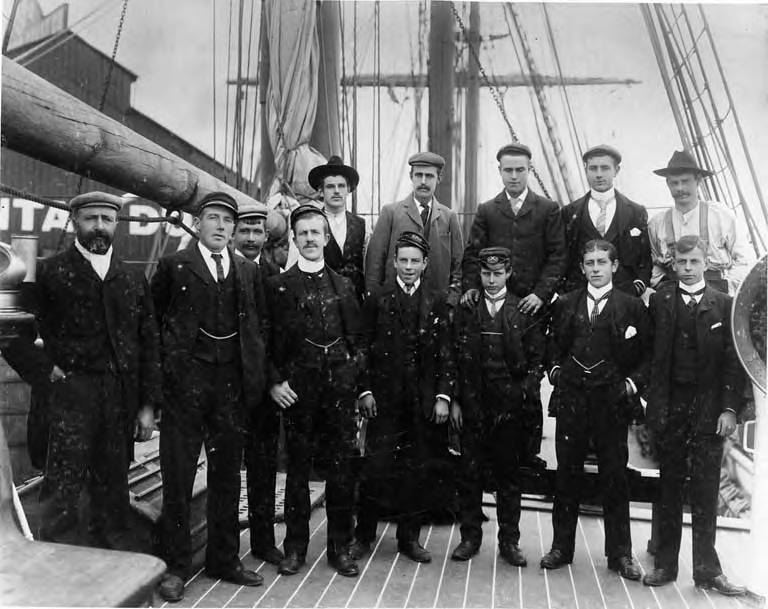
Crew of the Three-Masted Ship Arctic Stream on Deck, Washington, ca 1900.
Handwritten on verso: “ARCTIC STREAM 3 m. ship Capt. A. Bowen ARCTIC STREAM was built at Glasgow in 1885.
She was lost at sea in 1914