
Volunteer Jane Maddocks explores the story of the Lalla Rookh, lost in dense fog off the south Devon coast:
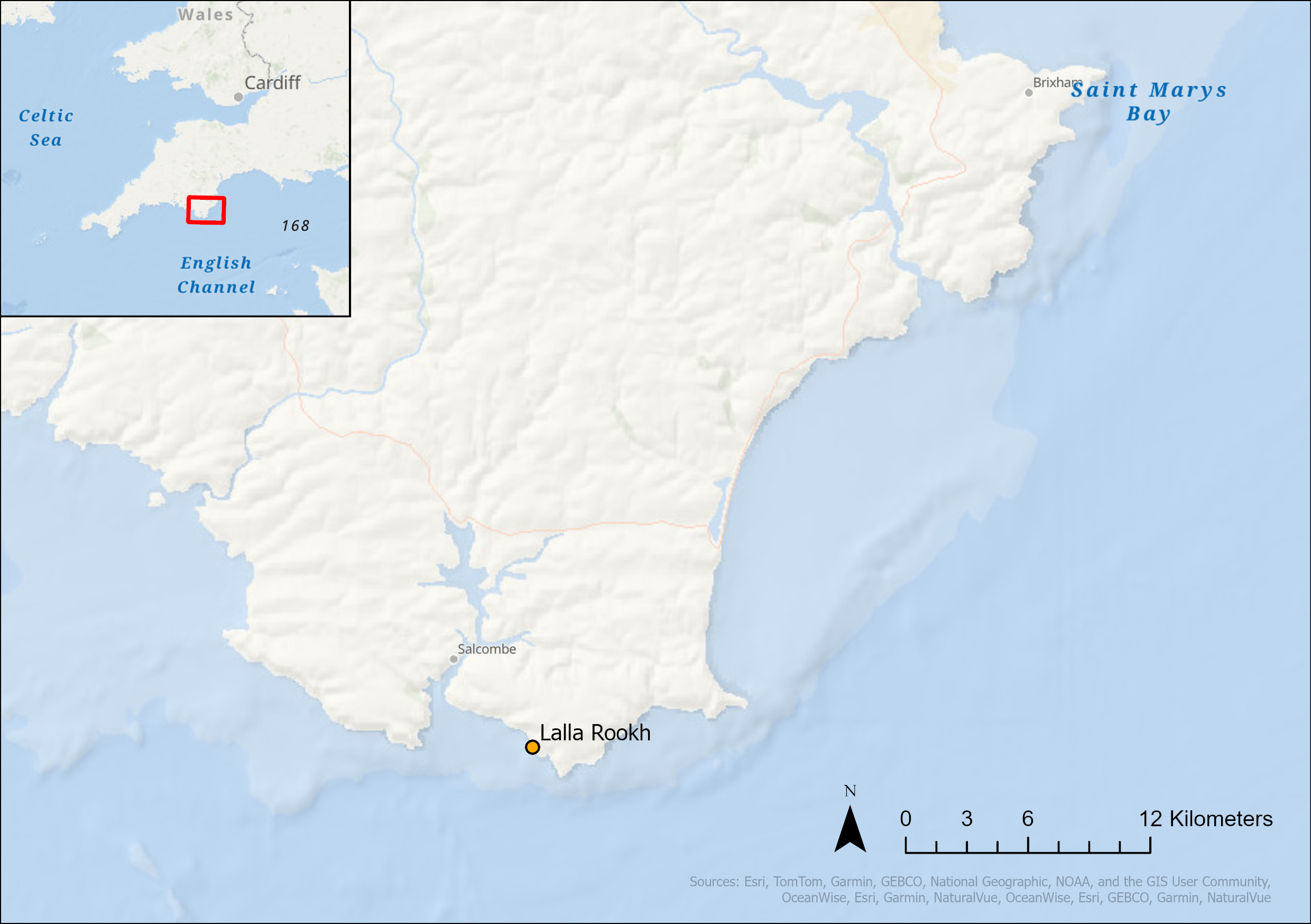
Lalla Rookh was a square-rigged, iron-hulled sailing ship, built by Jones & Co in 1856 in Liverpool in the UK. The ship was owned by Prowse & Co and was used to trade from Liverpool to India and China, carrying mixed cargo. On the final voyage the cargo consisted of tea and tobacco.
Wrecksite.eu describes the vessel as a ‘fully rigged sailing ship,’ with three masts and of 869 tons (gross tonnage) 54.56-m long, 10.12-m wide and hull depth of 5.82m (all hull measurements metricated).
On 22 October 1872, the ship left Shanghai bound for London, under Master George Fullerton and with a crew of 20 and cargo of 1200 tons of that season’s new leaf tea and 12 tons of good tobacco leaf. By the third of March, they were in the mouth of the English Channel. Then dense fog slowed their progress.
The fog was said to be so thick that the helmsman could not see the forecastle, and they passed the Lizard and Eddystone lights without seeing them or hearing the fog signals. The crew saw nothing until they steered onto Gammon Point, about three quarters of a mile west of Prawle Point on the South Devon coast. The ship struck the rocks then drifted into a small cove where the mizzen mast fell clear through the bottom plates and the ship quickly filled with water.
The crew managed to launch the lifeboat, but it was stove in and so became useless; an attempt to launch the port lifeboat was successful and ten men climbed into it only to be thrown into the boiling surf. They all managed to get back on board the ship, except the First Officer (First Mate) Thomas Groves who drowned. Within thirty minutes, fifteen of the crew were saved by the swift action of the Coastguard’s rocket apparatus and Breeches buoy, and the others saved themselves by jumping onto the rocks. Unfortunately, a stowaway, an American who had been discovered three days earlier after leaving Shanghai, who was very ill and said to be suffering from dysentery, had died in his bunk before the vessel stuck.
The ship drifted into Elender Cove, where it became a total wreck. Apparently, two lead lines were on board, but they were never used. The estimated value of the ship was worth £10,000 (approximately £1,389,496 today) and the cargo was valued at £50,000 (approximately £6,947,483 today), but the ship and the freight were insured for only £10,000 (approximately £1,389,496 today).
Enquiry and results
The Liverpool Mercury of Tuesday 25th March 1873 reported on the Board of Trade enquiry into the circumstances of loss. The Lalla Rookh was said to be well found and the cargo well stowed. The judgment following the loss acquitted the Master of all fault as he was on deck until midnight, communicating twice with the First Mate (who was an excellent officer) during the middle watch, then came up again at 04:00 am finding the ship still pursuing the proper course.
He was the first to spot the land and made ‘every exertion to save the ship,’ but it was too late. The court regretted that the First Mate had not taken the extra useful precaution of casting the lead (for the water depth measurements), which might have put him on his guard and warned him of approaching danger. It was also suggested that the compass may have gone wrong after losing the Lizard Light at 10:00 pm, and that magnetic deviation might have affected the ship’s compass. In the Dartmouth and South Hams Chronical on 28 March 1873, Captain Fullerton sent heartfelt gratitude from himself and crew to the Prawle and Rickham coastguard stations for their gallant conduct in the rescue of himself and the crew and offered sincere thanks to the Chief Officer of Prawle coastguard station, and the Chief Officer’s wife, for their kind and courteous treatment whilst he was an inmate of their house.
Survival and Investigation
It is reported in the Lloyds Register Salvage Association reports on 6 March 1873, that Lalla Rookh, Shanghai to London was wrecked at Prawle Point, and on 5 March they had succeeded in getting above the high-water mark, about 500 floating and stranded cases of tea, all more or less damaged. A large bank of loose tea lined the whole shore at the head of the cove. It also mentions that the ship parted amidships, the fore-end had capsized and fallen in, the decks burst, and the bulk of cargo was on shore by the sea. A large proportion of boxes containing the leaf tea were broken.
On 11 March, a newspaper reported that several cases of tea have this week been landed at the Custom House in charge of R. Grier, Esq., Receiver of Wreck. They have been picked up by the steamer Seamew, tender to HM Ship Achilles off Prawle Point, suspected to be part of the cargo of the Lalla Rookh which was a wreck. A newspaper report on 28 March states the schooner Charleton arrived at Southampton from Salcombe Bay this week with a cargo of damaged tea consisting of 872 packages, which had been saved from the wreck of the Lalla Rookh off Prawle Point. The tea was then conveyed to London.
Dismay and double dealing?
A couple of months after the wrecking, Dr Letheby, the medical officer of health for London had been informed of the public sale in the City of London of 1000 boxes of adulterated green tea. He visited the sale room where the tea was being sold in lots of 250 boxes each described as Extra Fine New Season’s Mayune Gunpowder Green Tea ex. Sarpedon steamship from Canton, but it had all been sold. He visited the bonded warehouse in Upper Thames Street and managed to obtain samples for careful examination.
He found the samples contained 20–43 per cent of iron filings and 19 per cent of silica in the form of fine sand, which had been cleverly mixed and added to the leaves before curling. After the leaves were curled, they had been thickly covered with green pigment and when infused in boiling water they produced a very turbid solution that smelt offensive and was noxious to the taste. The tea was part of the salvage of 1,150,000 lbs. of tea, which formed the cargo of the Lalla Rookh which had been brought to London, redried, manipulated to give it a decent appearance then repacked in old tea chests. All the samples were utterly unfit for human consumption.
Remains of Lalla Rookh
Sources say that the remains of Lalla Rookh lie beneath the sand in Elender Cove near Prawle Point as that is where the ship was wrecked and broke up (Clarkson, 2016). Research has not revealed details of any wreck remains that may be buried in that area. Some artefacts from a wreck in Elender Cover were declared to the Receiver of Wreck in on 1 August 1976.
The figurehead from the bow of Lalla Rookh is reported to have been washed up on the coast of Jersey in 1939 shortly before World War II. It is now preserved as part of the Long John Silver collection at the Cutty Sark Museum in Greenwich (Cutty Sark is now a museum ship). The figurehead represents Princess Lalla Rookh, who was a character in the romance poem by Thomas Moore in 1817. Wikipedia https://en.wikipedia.org.wiki/Lalla_rookh. [accessed 10 Feb 2026]
At present, research has not produced any leads to demonstrate evidence of the remains of Lalla Rookh in Elender Cove or the Prawle Point area, although many ships have been wrecked in the surrounding area of Prawle Point. It is possible that any trace of this once fine ship now remains buried beneath the sands of Elender Cove.
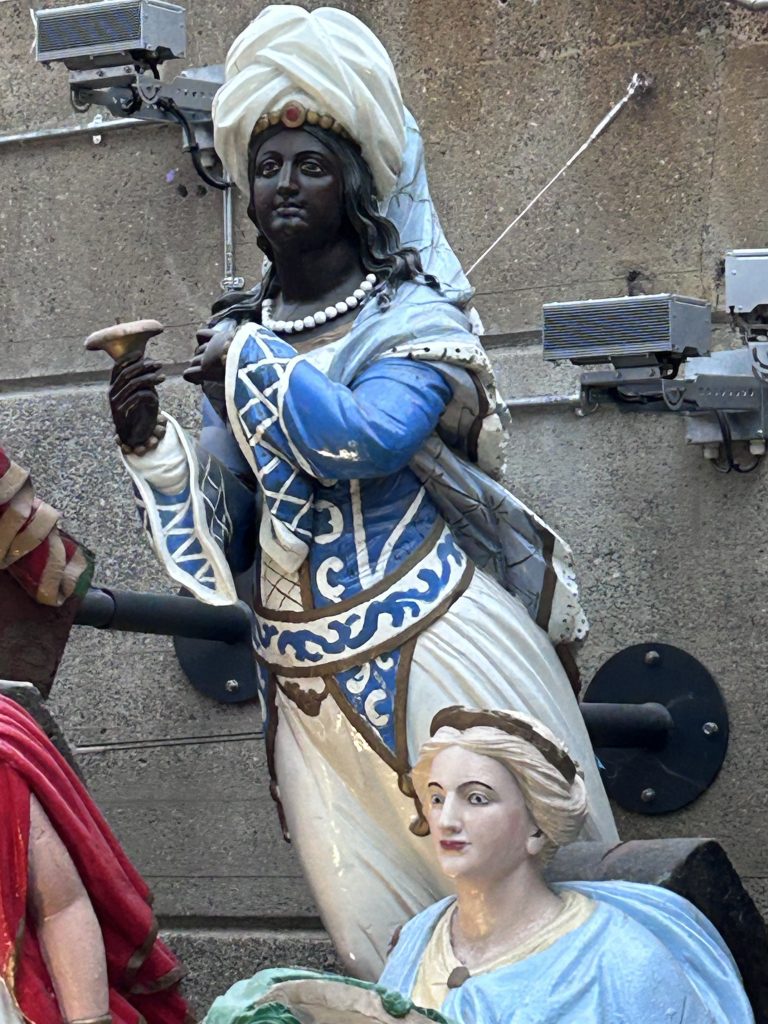
The figurehead of the Lalla Rookh.