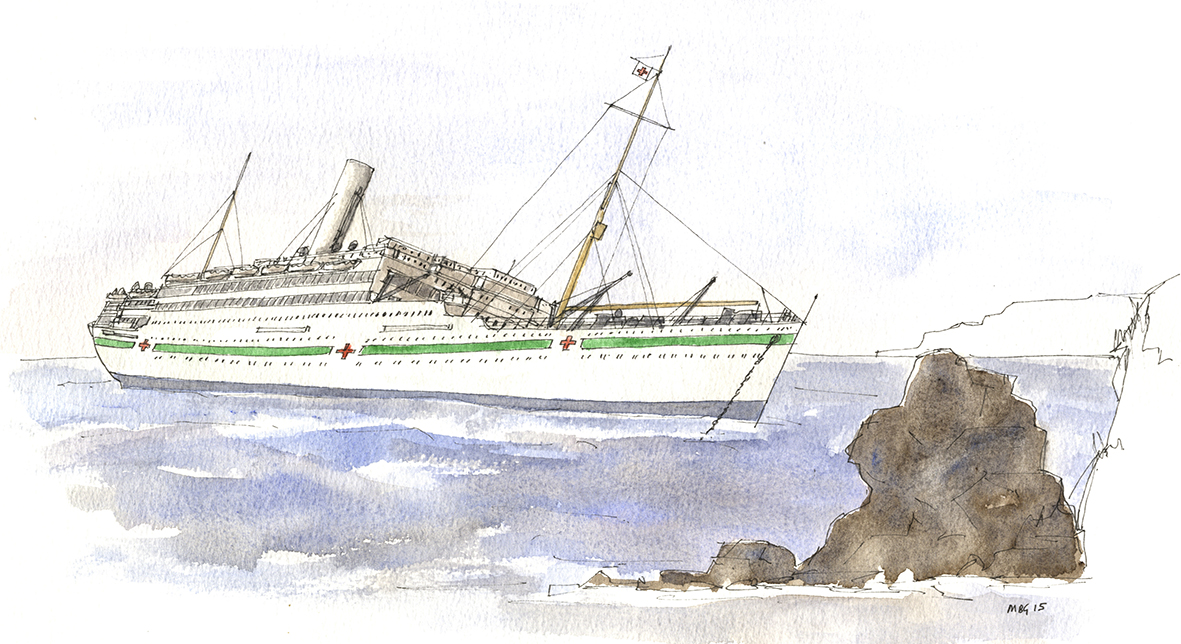
Michael Pitfield, tell the story of his relative, William Pitfield, who lost his life aboard the ill-fated HMHS Asturias.
Mention of the First World War often brings to mind the trenches of Flanders, the beaches of Gallipoli and other sites of conflict far away. Sometimes, however, disaster could strike much nearer home.
On March 21st, 1917, a torpedo struck the British hospital ship HMHS Asturias off the coast of Devon, marking a tragic event in the annals of the war. Among those who perished was John William Pitfield, a 25-year-old Engineer Officer whose life, and those of some 35 others, was cut short in service to his country.
Early Life and Career of John Pitfield
John Pitfield was the only son of William Pitfield (1867-1952), a railway worker, and his wife Annie Adams (1869-1969). In 1917 John, his sister Edith Mary, and their parents lived at Chapel Lawn, 114 Maumbury Way, Dorchester. Born in Weymouth in 1892, John initially followed in his father’s footsteps, starting his career on the London and South Western Railway (LSWR). At the age of 19, John’s adventurous spirit led him to join the Merchant Navy.
HMS Asturias: From Passenger Liner to Hospital Ship
Originally built in 1907 as a luxurious passenger liner for the Royal Mail Steam Packet Company, the Asturias was requisitioned by the Admiralty at the outbreak of World War 1 and converted into a hospital ship. Its large capacity and advanced medical facilities made it invaluable for transporting wounded soldiers from the front lines to England. To comply with the Hague Convention, the ship was painted white and adorned with large red crosses, clearly marking it as a protected hospital ship. International law dictated that such vessels were to remain unarmed and neutral, with belligerent forces expected to respect their immunity.
The Attack off Salcombe and John’s Death
In March 1917, the Asturias was returning to England from France after collecting wounded troops. On the night of March 21st, while sailing off the coast of Salcombe, Devon, the ship was struck by a torpedo fired from the German U-boat UC-66. The ship was sailing fully illuminated with navigation lights and the Red Crosses lit up to show it was a hospital ship and protected.
The impact caused a massive explosion, devastating parts of the ship and leading to significant loss of life, including that of John, when the torpedo struck. Despite being clearly marked as a hospital ship, the Asturias was deliberately targeted. The crew and medical personnel scrambled to respond to the emergency, but the damage was extensive, compromising the ship’s structural integrity and causing it to take on water rapidly. Through the crew’s efforts, the ship was eventually run aground near Bolt Head, preventing it from sinking completely.
Repercussions and Outrage
The torpedoing of the Asturias was widely condemned by the British government and its allies. The attack was seen as a flagrant violation of international law and an example of Germany’s increasingly aggressive submarine tactics. The Germans used the excuse of saying that hospital ships were vulnerable because the Allies were thought to be using them also to transport troops and ammunition.
The British press and public were outraged, viewing the incident as evidence of German barbarity. This attack was part of a broader pattern of unrestricted submarine warfare implemented by Germany in early 1917 – a policy that ultimately played a significant role in bringing the United States into the war. The indiscriminate sinking of neutral and non-combatant vessels, including hospital ships, hardened international opinion against Germany and fuelled calls for retaliation.
The Fate of HMHS Asturias
Though severely damaged, the Asturias was not entirely destroyed. After being salvaged, she was deemed unfit for further service as a hospital ship. Instead, she was repurposed as a troopship for the remainder of the war. Afterwards, the ship was restored and converted back into a passenger liner. Renamed Arcadian in 1923, she resumed commercial service until her eventual scrapping in the 1930s.
John’s Grave
John’s death was a profound loss for his parents and his wife, Lily Louisa Sansford, whom he had married the previous year. He was buried in Dorchester’s Weymouth Avenue Cemetery. His gravestone bears the inscription: John William Pitfield – Engineer of HMHS Asturias the dearly loved husband of Lily Louisa Pitfield who gave his life for his country March 21st 1917 aged 25.
The death of John William Pitfield on HMHS Asturias is a poignant reminder of the indiscriminate nature of war and the sacrifices made by those who sought to save lives amidst the conflict.
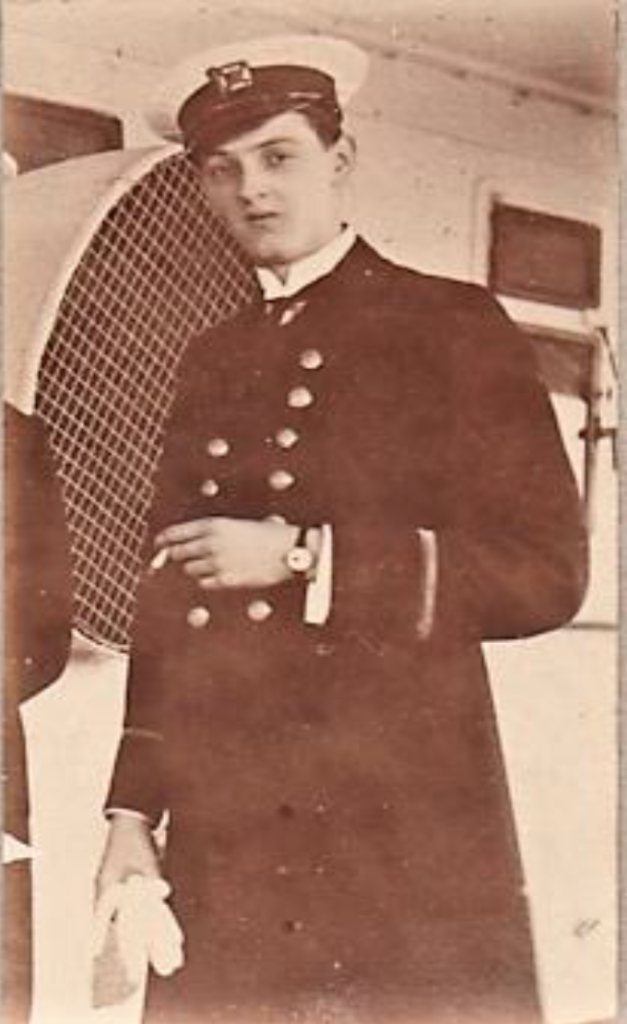
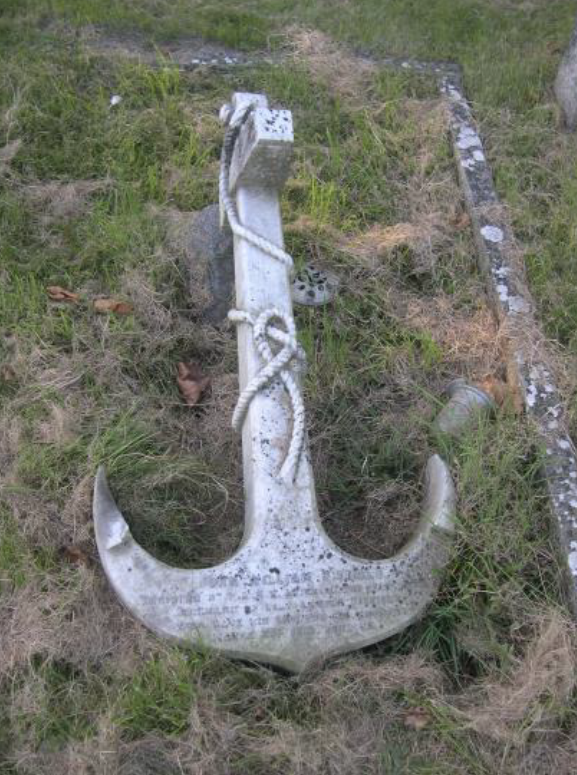
Left: John William Pitfield. Right: Pitfield’s grave. Image courtesy of Richard Smith.
Below: The Asturias, by Mike Greaves. Greaves2Connect.com